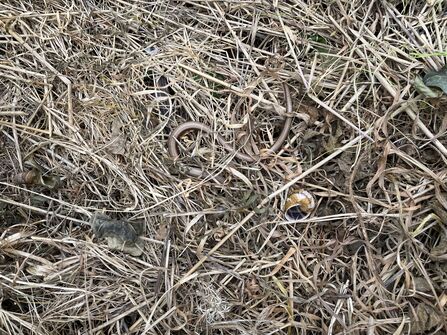
Key species: Slow worm

Key species: Slow worm

Slow worm - Josh Copping ©

Learn more about this unique species, the only reptile found on Alderney. Despite its misleading name, it’s actually a harmless legless lizard that is often mistaken for a snake because of its similar appearance.

I once received a message through the AWT social media asking what a particular creature was. The person who took the photo said they didn’t like the look of it.

The photo showed a long, slithering animal on the sand. It was a slow worm.

There have been no records of snakes on Alderney, and the slow worm is the island’s only reptile. Despite their appearance, slow worms are not snakes, they are legless lizards.

Slow worm - Josh Copping ©

Slow worm - Josh Copping ©

Slow worms were first recorded on Alderney in 1907 by Jersey naturalist Joseph Sinel.

Slow worms do not have the adorable appearance of a puffin, the charisma of a gannet, or the softness of a butterfly. Their face may look intimidating, but they are actually harmless. Their name is also misleading: a slow worm is not a worm, but a reptile.

Slow worms do not have a pronounced neck, so their head does not appear clearly distinct from the rest of the body. Unlike snakes, which do not have eyelids, slow worms have eyelids and can blink. Like other lizards, they can also shed their tails to escape predators. 

Slow worm

Slow worm / Photo by Sandy Robertson

Size: Adults can grow up to 50 cm long.

Average lifespan: 20-30 years

Oldest recorded slow worm: 54 years in captivity at Copenhagen Zoo.

Where can they be found?

Slow worms spend much of their time burrowing in loose soil and decaying vegetation. They are often found under logs, stones, or thick ground cover, and in woodland glades, allotments, and even gardens.

You are most likely to see them on warm days from late spring to early autumn.

On Alderney, slow worms are most commonly recorded along the south coast, particularly in Vau du Saou, where dense vegetation and suitable basking spots provide ideal habitat.

slow worm

Slow worm / Photo by Cris Rees

Slow worm’s food chain

Slow worms feed on invertebrates, including slugs, snails, spiders, and earthworms.

Slow worms’ predators include hedgehogs, other birds and pet cats.

Slow worm pair mating

©D.A. Trebilco

Their life cycle

Slow worms give birth to live young. The eggs hatch inside the female’s body, and the young are born in late summer, usually between August and September.

A litter usually consists of six to twelve young. A hatchling is about 4 cm long.

In autumn, slow worms enter brumation (a reptile form of hibernation). They shelter in rocky crevices, compost heaps, log piles, or other safe, damp places until spring.

Around March, slow worms emerge from hibernation.

The mating season takes place in April and May. During this time, males become territorial and may fight over females.

From June to August, female slow worms carry their developing young before giving birth in late summer.

The AWT’s slow worm survey

The AWT has carried out three surveys to better understand slow worm habitat preferences and their distribution across the southern and eastern parts of the island.

In spring 2025, the AWT launched an annual slow worm survey focusing on Vau du Saou, one of the most important slow worm habitats on Alderney.

How the survey is conducted

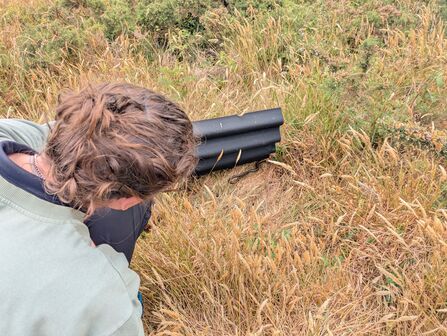
Reptile refuges, corrugated roofing felt that absorbs heat, are placed across the site starting in March. These are left undisturbed for a few weeks so that slow worms can settle beneath them.

From mid-April onwards, the team and volunteers check these refuges every two weeks, recording the presence of slow worms, their numbers, and their sex.

The survey pauses during the period when females give birth to avoid unnecessary disturbance to these reptile mothers.

You can encourage slow worms in your garden

Slow worms enjoy warm areas with plenty of invertebrates to feed on.

If you leave piles of sticks, prunings, or logs undisturbed in a quiet corner of your garden, they will gradually decompose and attract insects and worms. This may encourage slow worms to move in.

Setting up compost heaps is also a good idea, as slow worms often hide in them.

Other cool facts

  • Slow worms shed their skin in patches as they grow.
Slow worm skin

Slow worm skin / Photo by Thanh Doan

  • Slow worms have scales, but they appear smooth and shiny because their scales do not overlap and lack the raised ridge (keel).
  • Slow worms can deliberately shed their tails to escape predators. Although the tail can regrow, the new tail is usually shorter than the original and can no longer be shed.
Slow worm

Slow worm / Photo by Joshua Copping

  • Rough love: During courtship and mating, male slow worms bite the female around the neck or back, and the pair can remain locked together for up to 10 hours.

References

  1. Cox, T. (2025, April 1). The Secret Life of Slow Worms. AWT Magazine, Spring Issue 2025, 10–11.
  2. Hendry, L. (n.d.). Slow worms: Britain’s most unusual lizards. Www.nhm.ac.uk. https://www.nhm.ac.uk/discover/slow-worms-most-unusual-lizards-in-brita…