Key Species: Ringed Plover

Key Species: Ringed Plover

AWT staff

Alderney supports the Channel Islands’ last consistently breeding population of ringed plovers; learn more about this our key species.

I joined my first Wetland Bird Survey (WeBS) earlier in November, and in spite of the (very) wet weather, we still spotted some wading birds and seabirds. A favourite for me was a small group of ringed plovers on Platte Saline. This little wading bird is one our key species here in Alderney, and so it is the perfect focus for this month's blog.


What do they look like?

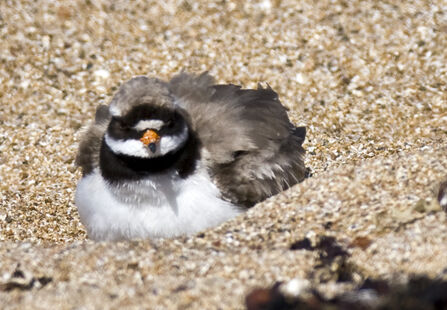
Many ID guides or pages describe them as 'dumpy' or 'rotund', which I think is pretty apt. They are smaller than most wading birds, including most other plovers. They have orange legs, a short black-tipped orange beak (which turns dark grey in winter). As their name suggests, they have dark rings around their necks and faces. They can sometimes be confused with the little ringed plover. Aptly named, they are smaller than ringed plovers and lack the bright orange legs and beak of their larger counterparts. They are very rare passage migrants to Alderney, and much less likely to be seen than ringed plovers.

A group of ringed plovers (small wading birds) in flight on a beach.

AWT staff

Wingspan: 35-40cm

Weight: 64g

Lifespan: 5 years

Where can they be seen around Alderney?

Ringed plovers can be seen all year round in Alderney, but are most commonly seen in the breeding season (April to July). Outside of these months, they are seen along both rocky and sandy coastlines, and into some freshwater habitats. At the most recent WeBS, we saw them at Platte Saline and Saye, which are two of their most frequent haunts on the island. If you approach a beach slowly and quietly, you'll be able to see most of the birdlife that scatters when people approach, including groups of ringed plovers.

Two ringed plovers stood on a sandy beach.

AWT Staff

Nesting Ringed Plovers in Alderney

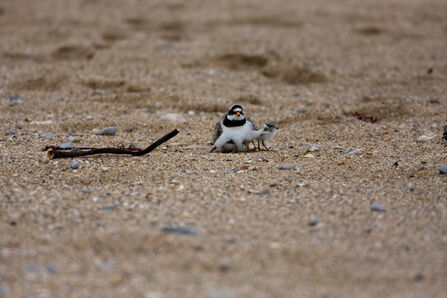
Alderney is a very special place for ringed plovers in the Channel Islands, as it is the last island in the region that they consistently breed on. From April, they start arriving and nesting on beaches such as Platte Saline. 

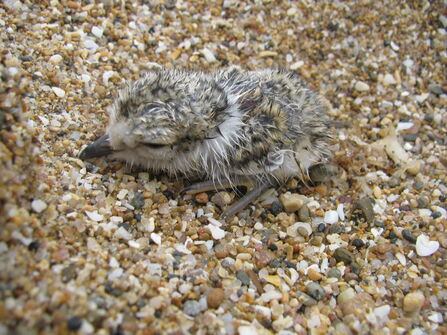
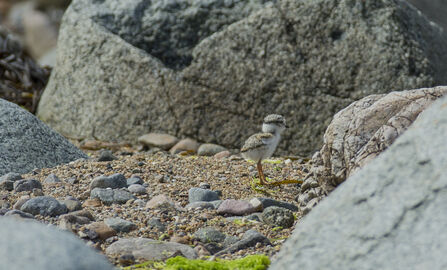
They will scrape a shallow dip in the sand to create their nest, where they then lay three or four eggs. The parents work together to incubate the eggs, taking turns over a period of around 25 days, before the chicks hatch. Chicks are able to move around very quickly after hatching, and fledge around 25 days later.

Because the eggs are so well camouflaged into sand and shingle, they can easily go unnoticed and nests can be subject to both trampling and disturbance. Parents are easily scared off of the nests, leaving eggs vulnerable to predation. It is vital to follow cordons and to keep dogs on short leashes on nesting beaches during the breeding season. The Alderney Wildlife Trust places cordons along Platte Saline in March to prepare for the nests.

In 2025, six pairs nested in Alderney, which is a decrease on 2023 and 2024 counts of seven pairs. Three chicks fledged in 2025. With the help of the island community, we hope that we can help our small breeding population to prosper and even grow into the future.

How you can help

  • Abide by cordons on Platte Saline from March into the summer, and do not come between adults and their chicks
  • Keep dogs on a lead and under control to avoid scaring parents away from their nests
  • Avoid walking along the upper beach in the breeding season, as this is where plovers usually create their nests.
  • Report your sightings of ringed plovers year round on the Alderney Biodiversity Centre website or in the sightings book in the Wildlife Information Centre on Victoria Street

Without the support of the Alderney community, the success we have seen in Alderney's breeding ringed plovers in recent years would not have been possible. All of us at the AWT are immensely grateful for the island-wide effort to protect these incredible little birds!